After a mere three years, Google News is rushing headlong out of beta. A new feature recommends "personalized" news on the basis of previous searches. Apropos our listserv discussion regarding the challenge of producing early-morning hardcopy newsclips for visitors etc., Google News presents a relatively graphic-free "suitable for cut and paste" list of news items if you select the text version option on the far right side of the screen. Each item leads with only the first sentence of the story, but that's often enough. More about the out of beta version here
Wednesday, January 25, 2006


New FirstGov
I happened by FirstGov yesterday, not realizing - until reading Gary Price's review today - that big changes underlie the new look. Read all about it at searchenginewatch

Monday, January 23, 2006
www.24eyes.com
With www.24eyes.com you can present RSS newsfeeds in however many windows (called "widgets") you care to arrange on the page. You can define the newsfeeds by selecting from dropdowns, by specifying an rss-feed url, or by searching for rss feeds by topic or provider (e.g. "state department"). You can also create a feed search; for example, by searching for"public diplomacy" in Google News, you've created an RSS feed for occurrences of those search terms that you can channel into one of your www.24eys.com windows. Finally, you're supposed to be able to publish your page and/or make it available to others, but I couldn't get either of those features to work (I've sent them a message about it...)

Thursday, January 19, 2006
Government Secrecy
This article by Laura Gordon-Murnane appears in the January 2006 issue of Information Today. It's a current and extensive compilation of resources on the government secrecy issue.
Wednesday, January 18, 2006
Monday, January 16, 2006
More on del.icio.us
Del.icio.us has been acquired by Yahoo, which perhaps is an indication that it may be around for a while. If you still haven't gotten started with this tool, "The Several Habits of Wildly Successful del.icio.us Users" is a short and to-the-point guide to what it can do and how you can use it.
Saturday, January 14, 2006
Library 2.0
Library 2.0 is a term that is much batted about the internet these days, perhaps as a natural follow-up to Web 2.0 Walt Crawford has devoted an entire issue of his "Cites & Insights" to surveying who has been saying what about it. Even if you find endless discussions about library and librarian identity dull, this is a useful catalog of who - and which blogs - are considered seminal in the N.American library community.
State of the Media 2005 report
Project for Excellence in Journalism (Columbia University Graduate School of Journalism) has released the 2005 State of the Media report. Among the highlights of the year cited in the introduction: "the blossoming of citizen blogs, the emergence of a major new news source edited entirely by computers (Google News), and both triumph (exposing the Abu Ghraib prison scandal) and failure (Memogate) for one of the TV networks. Customization, and with it fragmentation, reached new levels."
NewspaperArchive.com and Martin Luther King
NewspaperArchive.com's Martin Luther King archive provides free access to thousands of original newspaper articles about Martin Luther King. A great MLK Day/Black History Month resource for teachers/students.
Passport photo service
ePassportPhoto is a free service that enables users to create regulation-size passport photos from home-taken digital photos. If you don't have a printer, epassportphoto.com will mail you prints for a fee (that's what's in it for them...) It appears to be a legitimate site, with a reference link to travel.state.gov's photoguide. Although DOS could not openly promote a commercial service like this, it's something the Amcit/passport section might like to know about...?
Sunday, January 08, 2006
MIT Audits the Conventional Wisdom
Audits of the Conventional Wisdom from MIT's Center for International Studies "tours the horizon of conventional wisdoms that animate U.S. foreign policy, and put them to the test of data and history" (chosen as "site of the month" in the December 2005 issue of Foreign Service Journal)
Human Security Report
The first Human Security Report documents a dramatic, but largely unknown, decline in the number of wars, genocides and human rights abuse over the past decade. Published by Oxford University Press, the Report argues that the single most compelling explanation for these changes is found in the unprecedented upsurge of international activism, spearheaded by the UN, which took place in the wake of the Cold War. For more information see Human Security Gateway.
Friday, January 06, 2006
CRS Report. The Google Book Search Project
CRS Report. The Google Book Search Project: Is Online Indexing a Fair Use Under Copyright Law?
Summary:
Google, Inc. is digitally scanning the collections of several prominent libraries inorder to create a vast searchable database of literary works. Copyright holders who havenot authorized and object to the digitization have filed suit against the company. Thisreport provides background on the pending litigation. It will be updated as judicialdevelopments warrant.
Full text...
Thursday, January 05, 2006
10x10
10x10 is kind of a neat way of presenting the news, though I'm not sure how useful. The companion site, justcurio.us, is certainly useless - unless as a useful lesson in the pitfalls of so-called "architecture of participation."
Wednesday, January 04, 2006
Law Blogs
Law seems to be a field that is particularly well-represented in the blogosphere (e.g. bespacific, scotusblog, legalreader, to name but three), and www.blawg.org is a useful directory of legal and law-related blogs.
Tuesday, December 20, 2005
article about folksonomies
At the new blog Infotangle, there's an excellent overview of social bookmarking, folksonomies, and other Web 2.0 phenomena in the article "The Hive Mind: Folksonomies and User Based Tagging"
Currently in Congress December 1-15, 2005
The latest issue of Currently in Congress is available on the U.S. Mission to South Africa's Library webpage: http://pretoria.usembassy.gov/wwwhic00.html
Highlights: Defense spending bill, PATRIOT Act reauthorization, and the Border Protection, Antiterrorism, and Illegal Immigration Control Act.
Hearings include: Safety of Imported Pharmaceuticals, International Maritime Security, Response by Charities to Hurricane Katrina, and Avian Flu
Previous issues are archived on the website.
answers.firstgov.gov
For those experimenting with question and answer databases, answers.firstgov.gov might be an interesting example. It allows you to filter Q&As by topic, and also has a "People who viewed this answer also viewed:" feature.
Saturday, December 17, 2005
Bibliographies Compiled at Air Univerity Library
This is an impressive collection of topical bibliographies compiled by librarians at the Air University Library. See www.au.af.mil/au/aul/bi...
At long last, new Thomas look
Easier ways to post to ircworld and other blogger.com blogs
There are (at least) two shortcuts to posting to blogger.com blogs that bypass the cumbersome "go to blogger.com, remember your password and enter it, login, select create new post" procedure. One is to download the Google toolbar with the
A newer and more interesting variation, for Firefox users only, is the "Blogger Web Comments for Firefox" utility. This pop-up allows you to see what other people have said about a web page, and also allows you to send a post to the blog (to ircworld or any other blogger.com blog you're a member of) without leaving the page. It's an extremely handy tool...read all about it at
http://www.google.com/tools/firefox/webcomments/index.html
Link Harvester and Hub Finder
The monthly "Worthwhile Web" column on the OSIS net is always a reliable source of interesting web discoveries; this month I was delighted to find out about www.linkhounds.com . There are two tools here of particular interest; Link Harvester is a sophisticated tool for analyzing links to a particular domain or web page. Hub-finder identifies sites that have co-occurring link to sites on a particular topic. This can be very useful, and draws on the same logic that citation indexes used to identify relevant resources in the pre-online days. Let us say say you are looking for good sites on defense/security information. You submit up to 10 of your favorite security info sites to Hub Finder, and it will find additional sites that are linked to from at least two of the sites you entered. For example, I entered www.fas.org, www.cdi.org, and www.globalsecurity.org. Hub-finder then found 22 other sites with at least two matching backlinks, including several interesting sites that I'd not been aware of.
Thursday, December 15, 2005
National Archives
The National Archives website has a new look and lots of tantalizing information. Of particular interest is the new Access to Archival Databases (AAD) section, which enables common searching in multiple archives. See AP story (thanks to Resource Shelf for catching this)
Friday, December 09, 2005
For hours and hours of browsing pleasure...
...check out the Washington Post's new "U.S. Congress Votes Database" It let's you browse every voice in the U.S. Congress since 1991. Enjoy! Also a useful reference site..
Telling America's story....
Ordinary people are sometimes better public diplomats than government officials, and storytelling is an effective medium for creating people to people empathy and mutual understanding. Marylaine Block's December 9 "Ex Libris" article ( "Tell me a story") reviews several excellent storytelling sites on the web. Storytelling, and StoryCorps's Oral History Project, is also the cover story in this month's issue of American Libraries.
Thursday, December 08, 2005
Library 2.0
The Talis white paper Do libraries matter? The rise of Library 2.0 offers some interesting perspectives on the future of libraries. The authors propose a strategy for libraries to adjust to the emergence of Web 2.0, which incorporates some of those trends that have been discussed her lately, e.g. social bookmarking, the web as a platform for running applications, increasing democratization of the web, syndication (ie. pushing content rather than pulling audience), etc.
Tuesday, December 06, 2005
More fun in the classroom
National Center for Education Center's has some neat tools in its "Student's Classroom", including a handy "CreateAGraph" application that generates graphs and charts on the basis of input data.
Social bookmarking entering mainstream?
The November 22 edition of PC Magazine takes a look at what it describes as "community search engines", including del.icio.us (which by the way gets a poor score). For IRCworlders who are wondering what social bookmarking is all about, and enjoy the PC Mag style of comparing products, this article, "Never Search Alone" by Rick Broida, may be worth a quick glance. An indication that this type of online collaboration may be entering the mainstream?
Sunday, December 04, 2005
More on del.icio.us and social bookmarking
Del.icio.us and the social boomarking phenomenon is an interesting development worth looking into. An excellent introduction, that includes an overview of several social bookmarking tools (including CiteULike), is the article "Social Bookmarking Tools: a General Review" from the April 2005 issue of Dlib magazine. Jon Udell, creator of the wonderful "Walking Tour of Keene" screencast (see enthusiastic posting at ircworld in March, 2005) has also created a nifty screencast that provides a whirlwind 5 minute tour of del.icio.us from a user's perspective.
Friday, November 18, 2005
Fun in the classroom
Here a couple of creativity outlets that educators might find useful for teaching and/or silencing pupils. Imagination Cubed provides an online whiteboard for collaborative drawing. Neat! Sodaplay is an online Java-based simulator that allows users to construct robots and other mechanical creations and watch them walk, move, or fly.
Thursday, November 17, 2005
Neat marketing tool
Here's an excellent marketing tool for your next IRC event...just tell Albert what to write on the blackboard, and post it on your website.

Web Applications List
If you're interested in web applications, this is a goldmine:
http://www.webapplist.com/

Help drown out Oslo!
Couldn't resist reposting this, from ellensjourney.org - she's so right, especially about that Oslo IRC blabbermouth. I wish he would shut up - or better, that others would speak up.(send me an email if you forgot/need a userid/password) I also like her quote, "Library school is for geeks who don't do math."
Interesting library blog
The most (potentially) interesting library blog I have come across in a while is the ircworld blog - a team blog of all the Information Resources Centers at U.S. embassies around the world. Hopefully it will get off the ground more than it has so far, since right now it’s pretty much dominated by the Oslo IRC, which was the one that started it.
Eccentric Star
Eccentric Star is a public diplomacy blog by former USIA FSO Ann Driscoll. Contains many useful links to PD related blogs, websites, articles, etc.
Wednesday, November 09, 2005
CiteUlike
CiteULike "CiteULike is a free service to help academics to share, store, and organise the academic papers they are reading. When you see a paper on the web that interests you, you can click one button and have it added to your personal library. CiteULike automatically extracts the citation details, so there's no need to type them in yourself. It all works from within your web browser. There's no need to install any special software." This is neat - particularly for academic librarians, who might appreciate being told about this..When visiting certain supported sites (see list at http://www.citeulike.org/post), CiteUlike automatically extracts citation details. For sites that are not supported, you can type in the citation information manually. This is a nice way to build your personal library of "to read" items on the web.
Thursday, November 03, 2005
PandemicFlu.gov
PandemicFlu.gov: The official U.S. government Web site for information on pandemic flu and avian influenza.
Tuesday, November 01, 2005
Phil Bradley's "I want to" list
This is great...here is Phil Bradley's own description:
"I want to..." is a page of utilities, such as social utilities, social bookmarking and various other software packages that let you do things. (Added 27/10/05)
Most important govdoc reference sources
What are the essential 3-5 print Government Document reference sources that you can't work without in answering reference questions? Diane Kovacs posed the question to librarians on Govdoc-l, publib, libref-l, LIS-LINK, DIG_REF, ERIL-L, Buslib-L LawLibRef, Law-Lib@ucdavis.edu, LawSource, and the results are posted here.
Red Light Green
RedLightGreen is a useful tool from the Research Libraries Group for finding books and generating subject bibliographies. See Gary Price's short review in SearchEngineWatch 10/31. From the RLG website:
"RedLightGreen is one of our newest projects. It is designed specifically for undergraduates using the Web—and the libraries that support them. RedLightGreen.com delivers information from RLG members about more than 130 million books for education and research; and it links students back to their campus libraries for the books they select."

Friday, October 28, 2005
Useful links for Federal Investigation
Journalists covering the CIA leak might be interested in the following...
Web site of the Special Prosecutor
Handbook to the Federal Grand Jury system
FindLaw's collection of legal documents concerning the leak
Monday, October 24, 2005
Roll Your Own!
Rollyo enables you to limit a search to a user-specified subgroup of websites. (same idea as NeighborSearch, discussed here last year) Chris Sherman has provided a nice summary at Search Engine Watch

Friday, October 21, 2005
Improving public diplomacy in the Muslim world - interesting new article
Articles on how to fix public diplomacy are thick on the ground these days, and most of them are run of the mill stuff. This contribution to the debate is, I think, better than average. The author, Professor Richard Pells, visited Indonesia, and came up with interesting suggestions to improve public diplomacy in the Muslim world (though his suggestions have a wider application). One is to substantially enlarge and improve university collections of books, periodicals, and DVDs on American subjects beyond the level of American Corners, and another is to promote semester-long visiting professorships. Essentially, he believes ignorance of America, not ill-will towards America, is the real problem.
Read it for yourself at:
http://chronicle.com/temp/reprint.php?id=vzzg8kami4j4d7op4iqlskzi7kibed
or via the excellent Arts and Letters Daily web site at:
http://www.aldaily.com/
Tel Aviv IRC (Ralph Amelan)
What kind of dog are YOU?
As a lover of dogs, I'm of course familiar with the many services on the internet that can tell someone - on the basis of their answers to a few simple questions - what kind of dog they would be if they were a dog. The best of these services, in my qualified estimation, is the excellent Canine Algorithmic Transfer System at Gone2thedogs.com (click on "what dog are you" link). Personally, I'm very proud and happy to be a Spinone Italiano. I'm not sure how this resource can be used in IRCs or public diplomacy, but you should know that it exists!
p.s. - Just in. Believe it or not, one of my colleagues is a Norwegian Elkhound!!
Thursday, October 20, 2005
Another new resource from the Ralph Bunche Library
Once again the Ralph Bunche library has been adding new resources for our benefit, without fanfare.
The latest new database is HeinOnline. It has all sorts of legal goodies, including law reviews, US Attorney-General opinions, and the US Supreme Court Library.
While Lexis has most of the law reviews available at HeinOnline, it does not have them as far back. If you are looking for law review articles from the 1980s or before, HeinOnline should be your first choice of database.
Further, they have a 'Treaties and Agreements' library that is very extensive. The recently updated LLRX guide to researching US treaties and agreements (http://www.llrx.com/features/ustreaty.htm) features HeinOnline as an important resource.
And, for your arts contacts, the Ralph Bunche has added the Grove Art database (http://www.groveart.com/index.html) for a trial month. Thanks to Carla Higgins for passing the word on. If we find it useful, we may be able to subscribe to it for 2006.
Wednesday, October 19, 2005
Class Brain
This is a fun and attractive site that teachers might like to know about: www.classbrain.com

Tuesday, October 18, 2005
Uncommon Knowledge
Uncommon Knowledge
"In keeping with the traditions of the Hoover Institution, the programs feature lively debate on any number of topics, ranging from gun control to international foreign diplomacy. Visitors to the website can browse through a list of recent shows, or look through their archives which date from 1997. " Visitors may also wish to view the entire television program on their computer, listen to the audio presentation, or read a transcript." (annotation from Scout Report, 10/14/05) The "Browse Through Shows by Season" section includes discussions on many issues that might be of interest to secondary and university teachers/students.
Friday, October 14, 2005
English in the U.S.
The research pages of the U.S. English Foundation are a useful source of facts and statistics on U.S. population and language distribution. The U.S. English Foundation has a clearly articulated agenda, but the information at this site - derived from the 2000 census - can be of interest regardless of one's position on the "official English" issue.
Pledgebank
Pledgebank is an interesting approach to enlisting community participation for accomplishing common goals. Users make public resolutions (e.g. "I will contribute 20 dollars to Pakistani earthquake relief efforts") , on the condition that x number of others do the same by such and such a date. To facilitate local community empowerment (e.g. "I will petition the city council about reopening the neighborhood community center if 15 others do the same) Pledgebank also allows you to search for - and receive email notification - of pledges in your particular community.
Google Reader
Google now offers an RSS reader...see http://www.google.com/reader/ (requires a Google account)
Governing portal
Governing, the monthly magazine for state and local government officials, makes freely available the online supplement to its 2005 State and Local Sourcebook. Governing's ambition for the online supplement is to be "the Web's best gateway to state and local government information."
Making of America
From http://www.hti.umich.edu/m/moagrp/about.html:
"Making of America (MOA) is a digital library of primary sources in American social history primarily from the antebellum period through reconstruction. The collection is particularly strong in the subject areas of education, psychology, American history, sociology, religion, and science and technology. The book collection currently contains approximately 8,500 books with 19th century imprints. For more details about the project, see About MoA. New Additions: 33 more volumes focusing on New York City, many with a number of photographs, were recently added to MoA. Digital conversion of the volumes was made possible through a gift from UM alumnus Lawrence Portnoy. The digital conversion of the complete run of the Journal of the United States Association of Charcoal Iron Workers was funded by a generous donation from a Friend of the Library." For more on the value of this site to New York City history buffs in particular, see Debbie Nathan's article "The Past, in Pixels" in the NYT, August 14, 2005.
Tuesday, October 11, 2005
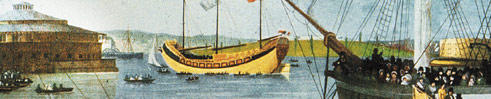
Castle Garden Immigration site
from www.castlegarden.org
"CastleGarden.org offers free access to an extraordinary database of information on 10 million immigrants from 1830 through 1892, the year Ellis Island opened. Over 73 million Americans can trace their ancestors to this early immigration period. Castle Garden, today known as Castle Clinton National Monument, is the major landmark within The Battery, the 23 acre waterfront park at the tip of Manhattan. From 1855 to 1890, the Castle was America's first official immigration center, a pioneering collaboration of New York State and New York City. "
Thursday, October 06, 2005
African American genealogy
and here's another genealogy site, from Marylaine Block's "Neat New Stuff" column
http://www.princeton.lib.nj.us/robeson/genealogylinks.html
"A thorough collection of links to beginners' guides, death records, federal
records, state guides, family histories, military services records, and more."
New resource from the Ralph Bunche library
Dear colleagues,
There is a new resource on the Ralph Bunche library web site, from the GalleryWatch people.
It is called GalleryWatch Foreign Policy Briefing, and it is listed on the Ralph Bunche Databases page.
It offers, on the left side of the page, a list of recently published CRS reports on foreign policy issues, and on the right, 'hot docs and press releases' which include GAO reports and government and congressional press releases.
At the foot of the page, there is a link to an appropriations and authorizations bill tracker for FY 2006, and a listing of upcoming congressional hearings. It seems to be updated every week.
This resource looks very useful, and saves burrowing through lists of CRS reports from the other GalleryWatch site for foreign policy material.
Happy hunting!
Ralph
Monday, October 03, 2005
Literature Map
Type in an author and Literature-Map generates a galactic map showing other authors that you may be interested in. Click on any author name and that author becomes the center of the map. (from Library Stuff)
Handbook for Bloggers and Cyberdissidents

Sunday, October 02, 2005
Experimental fiction
Literary contacts might like to be alerted to Ben Marcus's defense of experimental fiction in the October issue of Harpers. Not only is it a well-written and entertaining article about an interesting and much-discussed topic, it contains elements that suggest it may be a "debate in the making" - most notably a withering pronouncement on a more famous and successful writer (Jonathan Franzen) known for his withering pronuncements and - best of all - who might reasonably be expected to respond! Stay tuned!
Saturday, October 01, 2005
Memeorandum
Here's a interesting post from Inter-Alia, an "Internet Legal Research Weblog"...
Take a Meme-o
How often do you visit Memeorandum for the latest take on the news? Well, that's not often enough. This site is one of my favorite visits during the day; it takes important news articles throughout the day, and links directly to bloggers who are discussing them. All in one place, you get the story and the commentary, from all points of view.
And here's a feature you may not have noticed. Click on the Preferences link and select Show Link Search. Now, you'll be able to check Google Blog Search, Bloglines, Technorati, and IceRocket for even more sites that link to the particular article. Unfortunately, this feature's only available if you visit the site, so if you subscribe to the RSS feed, you're out of luck.
Centralization and collaboration
Nearly 10 years ago, in the March 1996 issue of the Atlantic Monthly, James Fallows's article The Java Theory outlined a scenario in which computing applications and even operating systems would move from personal computers to the net, ultimately displacing PCs with simple gateway devices that connect users to the internet. Several new and useful applications are nudging us in that direction, uniting the advantages of centralized processing and storage with the enormous power of thought and knowledge that a collaborative community - as opposed to a mere individual - can bring to a project. Wikipedia is the example that comes immediately to mind, but wikis are also a good tool for more local or limited collaborations (see f.ex. posting here about Peanut Butter Wiki) Writely is similar to a wiki, but provides the functionality and formatting possibilities of a word processor. It allows you to store and share your documents online, and grant editing privileges to other users. De.licio.us is one of several "social bookmarking" services services that allows users to store and organize their bookmarks on the web and share them with other users. Esnips is another servcie that enables centralized storage and sharing of information. Particularly convenient is the esnips toolbar (currently for IE only), which allows you to select images, documents, or segments ("snips") of text while browsing the web and store/categorize them in your esnips folder. You can read more about esnips in an a Mary Ellen Bates's "A new approach to sharing web research" The potential impact of on-site witnesses providing vital information to a virtual community was nicely demonstrated by Scipionus during the disaster in New Orleans. The empowerment of local citizens all over the world as global reporters is further exemplified by the profusion of blogs and emergence of a "blogosphere." When a news story breaks, professional journalists (and librarians) worth their salt will know the value of consulting their amateur counterparts in the blogosphere; Jonathan Dube at the Poynter Institute put together some useful tips on finding local blogs a few months ago.
Subscribe to:
Posts (Atom)


